
I arrived in Madang in 1953. My very first impression was that everything seemed to be in technicolour, as all the colours were brighter and more vivid than in Australia. The hibiscus flowers were a brilliant red and yellow and the trees, palms and plants a very bright green, in stark contrast to the grey-green […]
I arrived in Madang in 1953. My very first impression was that everything seemed to be in technicolour, as all the colours were brighter and more vivid than in Australia. The hibiscus flowers were a brilliant red and yellow and the trees, palms and plants a very bright green, in stark contrast to the grey-green colours with which I was familiar.
Initially, the weather did provide some problems, as it was not only hot, but extremely humid, especially during the day, although the mornings and evenings were most pleasant. There are only two distinct seasons, the ‘wet’ and the ‘dry’ and when it rains, it absolutely pours, and the rain can be heard approaching on the palm fronds.
There was so much new to absorb and cope with on arrival. Firstly, my woollens and stockings were put in the suitcase and not taken out again until I left. Cotton dresses were preferable to nylon, as nylon was inclined to stick to one’s body in the heat. I had also never before encountered leather shoes that went mouldy, nor ants that chomp their way through leather, nor huge cockroaches that FLEW! I did take a fancy to the chirpy, almost transparent little geckos, which would crawl up walls and ceilings to catch flying insects. One was required to ingest malaria tablets even before arriving, so the fact that trucks with huge containers of insect spray to eradicate mozzies rattled down the roads regularly, blowing out a mist of this spray, was very reassuring – especially as homes in Madang did not have windows, but rather louvres, and the spray thus penetrated through all the rooms.
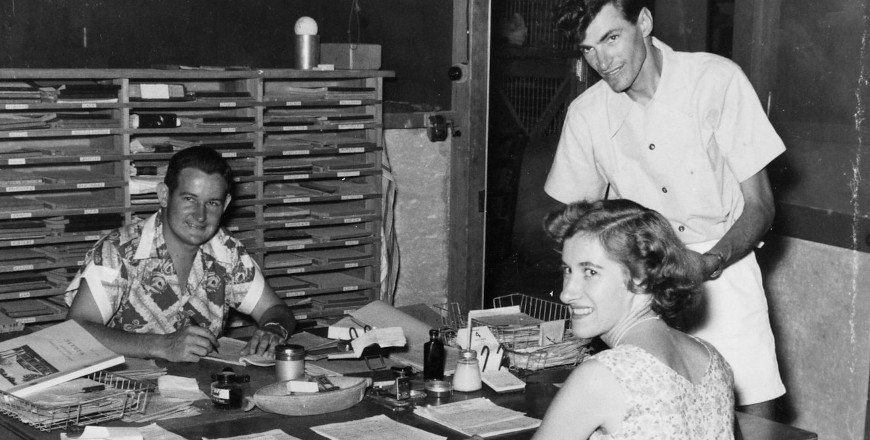
Supply Houses had originally been based in both Lae and Madang, but in 1953, they were consolidated by Bill Fugmann in Madang because of the excellent harbour. “Our” Supply House was a very large shed with an office at one end (no air-conditioning!). It was absolutely laden with goods of all kinds, from foodstuffs, to kitchen requirements, tools and other equipment, clothing, trade store articles, books from the printery etc. When an order came in from an outstation, the person in charge of finding and packing the required articles for delivery, was Harold Ziegeler who had arrived from South Australia about a year earlier. The goods were priced and invoiced by Ron Johnson of Queensland, who had arrived at about the same time as Harold, and me. The parcels and packages were then transported to the coast or highlands by the most suitable method, boat or plane. Roads from Madang for cars were very few at that time so there was no way to leave the area, other than to walk, fly, or go by boat.
By 1953, the ship which was used for most of the mission work was the Simbang, a vessel built in Brisbane and brought to Madang in 1952. Arthur Fenske (US) was captain and Lou Vogt (AUS) the engineer. It was 80 ft. long and could carry 14 European and 100 native passengers and up to 100 tons of cargo. It regularly travelled from Madang down the coast to Finschhafen and Lae, and other destinations.
After having used various planes over the previous years, the Mission received some assistance from the Missionary Aviation Fellowship (MAF), an international organisation of Christian pilots and technicians who had banded together after the war to further the cause of Christian missions throughout the world through aviation. They also gave valued advice to the Lutheran Mission in New Guinea and helped with manpower. The decision was made to use Cessnas, as these planes could carry three passengers, or a payload of 600 lb, in addition to the pilot. Eventually, a Super Piper Cub was also acquired for short airfields in the highlands.
Ray Jaensch (AUS), as well as Bob Hutchins and Tom Johnson (US) were pilots during my time, with Max Flavel (of the MAF) and Vic Ambrose. Of course, an additional need for them was radio communication between the planes, government stations, mission outstations, Madang and Lae. Carl Spehr (US) arrived in 1949 and began this program, which continued evolving over the years. The importance of this method of communication can be appreciated in a land where there were no telephones outside city and town areas and very few roads for cars.
Electricity was a reasonably rare commodity in my early days. Although homes did have electricity for some hours each day, initially there was no street lighting in Madang. Its arrival was a red-letter day for the town and we then only required torches to attend the cinema!! This was called the Tropical and was housed in a Nissen hut (left from the war). It boasted a dirt floor, deckchair type seats and was infamous for the continual breaking down of the films during the show (hence the torches). The natives’ dogs, which wandered through during the performances, were also part of the evening. The cinema mainly showed westerns, such as Roy Rogers and Trigger films, and we found a trip to the Tropical quite hilarious.
For many years, the needs of mission stations and their personnel were provided for on a communal system by the Lutheran Mission Supply House, which also catered for other Protestant Missions. The amount of accounting work (done in Lae), for about 80 stations and all the extra staff and manpower – in 1959, there were 295 European staff members – can be appreciated. As time went on, this method of providing for all became too unwieldy and the Supply House was eventually closed (in about 1970) when the goods and services required could be more readily obtained elsewhere.
After getting to know my co-workers Ron and Harold, and becoming proficient in the work allotted to me, I was soon able to move from boarding with pilot Bob and Betty Hutchins (US), (where I was introduced to iced tea as well as iced ‘wahter’), into my new abode. This was a bedroom in Ray and Betty Jaensch’s home, with a small living room, almost like a bubble attached to the outside. Pilot Ray and Betty (both from SA), had been married for only a short time and were a lovely couple who made me very welcome. I settled down to work as Bill Fugmann’s secretary, writing letters (in German and English), as well as invoicing with Ron, goods packed by Harold and the native boys, then sent out of the store. In those years, other than the normal everyday things (food etc.) which were imported from Australia, goods such as tools and other such specialty items needed to be ordered from England, Germany, or the States. These required import licences, delivery by boat and clearance through customs at the wharf on arrival. The whole procedure could take up to a year. As this was the type of work with which I was familiar, it was no trouble for me and eventually I was asked by the customs folk at the wharf if I would like to become a customs agent. I would not have minded, but there was a catch – a fee of 100 pounds Australian!! As neither I nor the Mission were prepared to pay this cost, the offer lapsed. But in retrospect, I could have been the only female customs agent in Madang! Bill had contacts in Germany for good quality articles and many, such as Voigtlaender cameras and Loewe radios, could be ordered by the mission staff on request. We also were able to access Monty Ward catalogues. These were mail order catalogues from Montgomery Ward in the States, which had – you name it, it was advertised – goods of all and every description. It was something new for the Australians and very popular.
After a few months, a new member of staff arrived. Winifred Uebergang from Dalby, Queensland visited her brother, Rufus, who was stationed on Rook/Siassi Island, the ELCA Mission. She came through Madang, where she was co-opted to help in the store for a number of months. We four, Harold, Ron, Win and I got along famously and had lots of fun. Winifred later went on to Lae, where she subsequently lived for some years, after having married Bob Cowell.
Towards the end of 1954, Bill and Hertha Fugmann and their four children who had been at boarding school in Brisbane, left to return to Germany on leave. I was sad to see them go, as my contract was to run out before their return to New Guinea. Our next store manager was Doug Daechsel (US) who came with wife Doris and children – also all with names beginning with ‘D’ (Donna, Dawn, Darlene, and Daniel). The last new member of staff to arrive was Rosalind Stolz (AUS), now Lieschke. She arrived in May 1955 and remained until early 1956. Rosie also soon became a great friend.
Towards the end of 1954, I was asked to move to the home of Erna and Kurt Hofius, as Betty was expecting, and they would eventually need my room for the babe. This meant that I moved to the other end of the town. Erna and Kurt were German missionaries who served the Chinese in Madang as well as working amongst the natives in labour compounds in the area. They were most interesting, as Kurt had been a missionary in China from 1934 to 1947, then a pastor in America for two years, before arriving in Madang in October 1952. Living with them, I became aware of various Chinese customs, such as the Chinese Dragon, which came to the Chinese homes on New Year’s Day. I was absolutely captivated, as the dragon was a most beautiful sight and pranced around whilst firecrackers were let off outside each home. He was accompanied by his ‘orchestra’, seated on the back of a truck. Gifts of money were wrapped in red paper and hung from the roof and whilst more crackers were lit and exploded, (the noise was incredible) the dragon would rear up and ‘gobble’ up the gift.
After work and at weekends we went to all the church and other dedications on the various stations in the area. These always included a great meal, staff picnics per Simbang to Bilibil, – visits to the technical college at Baitabag, at that time run by Doug Kohn (AUS), where the boys showed me how to ride a motor bike but forgot to mention the brake, which resulted in my ending up in the garage door. There were welcome lunches for new staff members or farewells for those going on leave (or furlough as the Americans called it).
We also spent many a pleasant Saturday afternoon taking the ‘tinny’ or ‘lik lik Simbang’ across to Graged Island to visit Lorna and Lou Vogt (SA), for firstly a swim, then a delicious tea provided by Lorna, followed by a long game of Canasta. One trip remains particularly in my memory. One night we returned home across the bay when there was no moon and a blackout in Madang. It was so intensely dark, that for a while we had absolutely no idea where we were and floundered around the bay until eventually someone saw something familiar looming ahead.
On long weekends, we took trips further afield, such as a boat trip to Karkar Island, north-east of Madang, to visit with Edwin and Tabitha Tscharke (AUS). Ed with Tabitha’s assistance had established a hospital on the island and had become very well-known and admired in New Guinea for their work with sick natives. This island was where I saw a cocoa tree for the first time and was quite amazed at the cocoa pods hanging off the trunk of the tree, without a stem. These trees were planted as an under-story for the coconut palms and did very well there. Some coffee bushes were also planted, and I still maintain that New Guinea coffee is THE VERY BEST coffee.
Other trips included a few flights to the highlands. The first time, we flew with Robbie Robinson, who was a commercial pilot and owned an Auster (biplane). It had definitely seen better days, was probably pre-war and moaned and groaned attempting to get high enough NOT to take the tops off the palms in the coconut plantation! I was not happy during that flight and heaved a great sigh of thanks and relief when we arrived at our destination.
Flying within New Guinea is an art! It was not permitted unless the visibility was such that one can see exactly where one wishes to go. No instrument flying was allowed, so if clouds were in the way, flying through them was not permitted and one had to turn back. This was due to the country being so mountainous and rugged, that clouds could well be hiding the higher peaks.
We once flew to Banz with a DC3 and stayed with Rosie’s sister Theophila and her husband Leon Phillipi (US). This too was most interesting, as we were able to take a drive through parts of the Waghi valley, first to Chuck Pfarr at Kotna and then even as far as the Strauss family at Ogelbeng. On that trip, Harold had great difficulty in keeping the jeep on the muddy and slippery, winding, and narrow road and not sliding over the edge, as one side went up the mountain and the other straight down an extremely long, steep drop to the river far below. All roads in the highlands were man-made, i.e. dug out of the hills by hand by the natives, as heavy machinery was at first not available and later needed to be flown in. On this trip, we witnessed the very first wedding at which Leon was to officiate. Three Swiss Brethren (an Anabaptist group) had initially arrived to establish their Mission and their brides-to-be had now followed and the triple wedding was to take place at their station. It was followed by the obligatory kai-kai (very tasty native food of pork and/or chicken, taro and other vegetables wrapped in banana leaves and cooked in the ground under hot stones).
We were able to have a break after a year’s service, and I took that to travel per Simbang to Finschhafen and Lae. As always, there was much new to see and in Finschhafen I was able to visit Sister Helene Moll, an elderly German nurse whom I knew from Camp. She worked in the laboratory at the hospital and showed me around the area. In Lae, I visited Winifred (by now the wife of Bob Cowell), who took me to see the city, including the huge war cemetery and other sights. I found Lae at the time to be much larger and more progressive than Madang but was quite happy to get back to ‘our’ area, to my work and the folk I knew.
I took two more trips, one as a visitor to the Conference on 13th February 1956, in Wau, where the plane lands on a strip which goes up hill and where we were accommodated in the Katherine Lehmann School (the boarding school for mission children), during their holidays. This was a particularly important synod, as it was to commemorate 70 years since Missionary Johannes Flierl had set foot in New Guinea and founded Lutheran Mission near Finschhafen, as well as putting forward the vote to set up the Evangelical Lutheran Church of New Guinea, (ELCONG), which was to include the indigenous people. Several overseas visitors attended, including Director Hans Neumeyer from Neuendettelsau, Dr. (later Bishop) F. Birkeli from Norway representing the Lutheran World Federation, Dr. M. Lohe (UELCA, Aus), and Dr. Henry F. Schuh, President and Dr. George Schultz, Secretary, from the American Lutheran Church. There were also native delegates from the churches of the various areas. The Synod chose Dr. John Kuder as the church’s first Bishop. After the festivities were completed, a side trip took us to the Wau goldfields, and a plywood factory.
The town of Madang was reasonably small, but it had a magnificent harbour, made up of innumerable islands, bays and promontories, which were at first rather disconcerting, as I never quite knew where I was. Fortunately, for the first week or so, I was assigned a native driver (named Dope), who made sure I would get to work on time and did not get lost. The roads were made of crushed coral that was brilliant when it rained, as the water soaked away very quickly.
Madang was an extremely busy hub, where people from near and far (other areas of New Guinea, Australia, Germany, or USA), came to go to the highlands or along the coast, and had their trips by plane or boat, organised at ‘the Store’. I did pride myself at the time on the fact that I had met the majority of the mission personnel as they came through Madang during the 2.5 plus years I was there. This meant that when Eric Hoopmann, a young doctor from South Australia and my future husband, arrived in 1954 to go to the Western Highlands (now Enga Province), I met him too! He was returning to New Guinea, as he had been in Madang in 1951 and 1952, initially as a graduate to acquire knowledge and experience in tropical medicine from Dr. Braun, before relieving him at the hospital in Yagaum for a year whilst he went back to the States on furlough. After Dr. Braun had returned to New Guinea, Eric travelled back to South Australia to assist his uncle, a doctor, until the American Lutheran Mission of Wabag/Mambisanda had indicated that it was in a position to begin building a hospital there. As a smoker, he needed cigarettes and some reading matter, which I was able to send him occasionally.
At Easter in 1956, we four at the store decided to go to see what the Western Highlands were like. At 5,000 ft above sea level the Western Highlands are quite beautiful, although extremely rugged with steep hills and very deep gorges in which the fast-flowing rivers rush between huge boulders when it rains heavily at night. We saw the half-completed hospital, native wards and administration building, as well as the hydroelectric scheme being constructed where, at that altitude, fossilised seashells were found! We also admired the natives of the area, who were called Wigmen. Their headdress is carefully tended, fluffed up hair, quite like a wig which is not removed, but over time increases in size as more and more hair is added. They carry small sticks in their ‘wig’ so they can scratch their head if necessary! A small side trip by jeep, took us to the mission at Wabag, where to my surprise, we sat in front of a fire for afternoon tea, as it really was quite chilly.
My time in New Guinea was coming to an end as I had not renewed my contract. It had been for two years, but I had stayed on for an extra eight months as the Mission had not found a replacement.
Things that I now particularly like to remember are the closeness of all the staff and mission folk, the Sunday school children I taught, the market (Bung), the fish which flew into our boat one day in the bay, and the sing sings, which really impressed me with their incredible (all night) drumming and with row upon row of natives, beautifully adorned in brightest paints as well as shells and feathers, stomping about for hours on end. It was quite a sight and sound – as well as smell – particularly in Madang, as there were so many tribes from near and far represented, that they practically covered the whole of the oval. I also remember the oval with the beautiful poinciana trees, the Anzac Day gatherings, and the Madang Show. Last but certainly not least, I remember the Pidgin language, which I particularly loved with its quirky description of things. The only thing against remaining in New Guinea was the unrelenting humidity and probably homesickness for my family and worry as to how Mum was faring.
I booked to return to Australia on the Bulolo and left Madang with a heavy heart in August 1956, after being offered the use of warm clothes by those that had kept them, for my return to a wintry Sydney. The boat trip was via Rabaul in New Britain, (where the sand on the beaches was still quite black from the eruption of 2 volcanoes in 1937), Samarai, then Port Moresby, (where I saw the very large Hanuabada native village built on poles over the sea), and on to Brisbane. I then travelled the short distance to Toowoomba by bus to again catch up with Winifred. A long and freezing all-night bus ride followed, from Toowoomba via Glen Innes on the New England highway to Sydney, where Grete Glockemann was waiting at the bus stop to take me to her home. I stayed a day or so and then continued by bus to Bowna, which is about 35 kilometres north of Albury, to Mum and Wally. After not having seen one another for over 2.5 years, it certainly was quite a reunion.
If you would like to consider the opportunity to serve as a volunteer in mission, serving in practical ways, teaching English, teaching in the seminaries and institutions of our partner churches, or in local churches, you are invited to phone LCA International Mission on (08) 8267 7300 or email lcaim@lca.org.au. For more information, go to https://www.lcamission.org.au/join-gods-mission/volunteer/
Read more stories about volunteering at www.lcamission.org.au/category/join-gods-mission/volunteers/

0 Comment